


Showing posts with label Guest Ranter. Show all posts
Showing posts with label Guest Ranter. Show all posts
Wednesday, 11 September 2013
Tuesday, 10 September 2013
My fellow Americans, tonight I want to talk to you about Syria, why it matters and where we go from here. Over the past two years, what began as a series of peaceful protests against the repressive regime of Bashar al-Assad has turned into a brutal civil war. Over a hundred thousand people have been killed. Millions have fled the country. In that time, America has worked with allies to provide humanitarian support, to help the moderate opposition and to shape a political settlement.
But I have resisted calls for military action because we cannot resolve someone else's civil war through force, particularly after a decade of war in Iraq and Afghanistan.
The situation profoundly changed, though, on August 21st, when Assad's government gassed to death over a thousand people, including hundreds of children. The images from this massacre are sickening, men, women, children lying in rows, killed by poison gas, others foaming at the mouth, gasping for breath, a father clutching his dead children, imploring them to get up and walk. On that terrible night, the world saw in gruesome detail the terrible nature of chemical weapons and why the overwhelming majority of humanity has declared them off limits, a crime against humanity and a violation of the laws of war.
This was not always the case. In World War I, American GIs were among the many thousands killed by deadly gas in the trenches of Europe. In World War II, the Nazis used gas to inflict the horror of the Holocaust. Because these weapons can kill on a mass scale, with no distinction between soldier and infant, the civilized world has spent a century working to ban them. And in 1997, the United States Senate overwhelmingly approved an international agreement prohibiting the use of chemical weapons, now joined by 189 government that represent 98 percent of humanity.
On August 21st, these basic rules were violated, along with our sense of common humanity.
No one disputes that chemical weapons were used in Syria. The world saw thousands of videos, cellphone pictures and social media accounts from the attack. And humanitarian organizations told stories of hospitals packed with people who had symptoms of poison gas.
Moreover, we know the Assad regime was responsible. In the days leading up to August 21st, we know that Assad's chemical weapons personnel prepared for an attack near an area they where they mix sarin gas. They distributed gas masks to their troops. Then they fired rockets from a regime-controlled area into 11 neighborhoods that the regime has been trying to wipe clear of opposition forces.
Shortly after those rockets landed, the gas spread, and hospitals filled with the dying and the wounded. We know senior figures in Assad's military machine reviewed the results of the attack. And the regime increased their shelling of the same neighborhoods in the days that followed. We've also studied samples of blood and hair from people at the site that tested positive for sarin.
When dictators commit atrocities, they depend upon the world to look the other day until those horrifying pictures fade from memory. But these things happened. The facts cannot be denied.
The question now is what the United States of America and the international community is prepared to do about it, because what happened to those people, to those children, is not only a violation of international law, it's also a danger to our security.
Let me explain why. If we fail to act, the Assad regime will see no reason to stop using chemical weapons.
As the ban against these weapons erodes, other tyrants will have no reason to think twice about acquiring poison gas and using them. Over time our troops would again face the prospect of chemical warfare on the battlefield, and it could be easier for terrorist organizations to obtain these weapons and to use them to attack civilians.
If fighting spills beyond Syria's borders, these weapons could threaten allies like Turkey, Jordan and Israel.
And a failure to stand against the use of chemical weapons would weaken prohibitions against other weapons of mass destruction and embolden Assad's ally, Iran, which must decide whether to ignore international law by building a nuclear weapon or to take a more peaceful path.
This is not a world we should accept. This is what's at stake. And that is why, after careful deliberation, I determined that it is in the national security interests of the United States to respond to the Assad regime's use of chemical weapons through a targeted military strike. The purpose of this strike would be to deter Assad from using chemical weapons, to degrade his regime's ability to use them and to make clear to the world that we will not tolerate their use. That's my judgment as commander in chief.
But I'm also the president of the world's oldest constitutional democracy. So even though I possessed the authority to order military strikes, I believed it was right, in the absence of a direct or imminent threat to our security, to take this debate to Congress. I believe our democracy is stronger when the president acts with the support of Congress, and I believe that America acts more effectively abroad when we stand together.
This is especially true after a decade that put more and more war-making power in the hands of the president, and more and more burdens on the shoulders of our troops, while sidelining the people's representatives from the critical decisions about when we use force.
Now, I know that after the terrible toll of Iraq and Afghanistan, the idea of any military action, no matter how limited, is not going to be popular. After all, I've spent four and a half years working to end wars, not to start them. Our troops are out of Iraq, our troops are coming home from Afghanistan, and I know Americans want all of us in Washington, especially me, to concentrate on the task of building our nation here at home, putting people back to work, educating our kids, growing our middle class. It's no wonder, then, that you're asking hard questions. So let me answer some of the most important questions that I've heard from members of Congress and that I've read in letters that you've sent to me.
First, many of you have asked: Won't this put us on a slippery slope to another war? One man wrote to me that we are still recovering from our involvement in Iraq. A veteran put it more bluntly: This nation is sick and tired of war.
My answer is simple. I will not put American boots on the ground in Syria. I will not pursue an open-ended action like Iraq or Afghanistan. I will not pursue a prolonged air campaign like Libya or Kosovo. This would be a targeted strike to achieve a clear objective: deterring the use of chemical weapons and degrading Assad's capabilities.
Others have asked whether it's worth acting if we don't take out Assad. As some members of Congress have said, there's no point in simply doing a pinprick strike in Syria.
Let me make something clear: The United States military doesn't do pinpricks.
Even a limited strike will send a message to Assad that no other nation can deliver. I don't think we should remove another dictator with force. We learned from Iraq that doing so makes us responsible for all that comes next. But a targeted strike can make Assad or any other dictator think twice before using chemical weapons.
Other questions involve the dangers of retaliation. We don't dismiss any threats, but the Assad regime does not have the ability to seriously threaten our military. Any other -- any other retaliation they might seek is in line with threats that we face every day. Neither Assad nor his allies have any interest in escalation that would lead to his demise. And our ally Israel can defend itself with overwhelming force, as well as the unshakable support of the United States of America.
Many of you have asked a broader question: Why should we get involved at all in a place that's so complicated and where, as one person wrote to me, those who come after Assad may be enemies of human rights? It's true that some of Assad's opponents are extremists. But al-Qaida will only draw strength in a more chaotic Syria if people there see the world doing nothing to prevent innocent civilians from being gassed to death. The majority of the Syrian people and the Syrian opposition we work with just want to live in peace, with dignity and freedom. And the day after any military action, we would redouble our efforts to achieve a political solution that strengthens those who reject the forces of tyranny and extremism.
Finally, many of you have asked, why not leave this to other countries or seek solutions short of force?
And several people wrote to me, we should not be the world's policeman. I agree. And I have a deeply held preference for peaceful solutions. Over the last two years my administration has tried diplomacy and sanctions, warnings and negotiations. But chemical weapons were still used by the Assad regime.
However, over the last few days we've seen some encouraging signs in part because of the credible threat of U.S. military action as well as constructive talks that I had with President Putin. The Russian government has indicated a willingness to join with the international community in pushing Assad to give up his chemical weapons. The Assad regime has now admitted that it has these weapons and even said they'd join the chemical weapons convention, which prohibits their use.
It's too early to tell whether this offer will succeed, and any agreement must verify that the Assad regime keeps its commitments. But this initiative has the potential to remove the threat of chemical weapons without the use of force, particularly because Russia is one of Assad's strongest allies.
I have therefore asked the leaders of Congress to postpone a vote to authorize the use of force while we pursue this diplomatic path. I'm sending Secretary of State John Kerry to met his Russian counterpart on Thursday, and I will continue my own discussions with President Putin. I've spoken to the leaders of two of our closest allies, France and the United Kingdom. And we will work together in consultation with Russia and China to put forward a resolution at the U.N. Security Council requiring Assad to give up his chemical weapons and to ultimately destroy them under international control.
We'll also give U.N. inspectors the opportunity to report their findings about what happened on August 21st. And we will continue to rally support from allies, from Europe to the Americas, from Asia to the Middle East who agree on the need for action.
Meanwhile, I've ordered our military to maintain their current posture, to keep the pressure on Assad and to be in a position to respond if diplomacy fails. And tonight I give thanks again to our military and their families for their incredible strength and sacrifices.
My fellow Americans, for nearly seven decades the United States has been the anchor of global security. This has meant doing more than forging international agreements. It has meant enforcing them. The burdens of leadership are often heavy, but the world's a better place because we have borne them.
And so to my friends on the right, I ask you to reconcile your commitment to America's military might with a failure to act when a cause is so plainly just.
To my friends on the left, I ask you to reconcile your belief in freedom and dignity for all people with those images of children writhing in pain and going still on a cold hospital floor, for sometimes resolutions and statements of condemnation are simply not enough.
Indeed, I'd ask every member of Congress, and those of you watching at home tonight, to view those videos of the attack, and then ask: What kind of world will we live in if the United States of America sees a dictator brazenly violate international law with poison gas and we choose to look the other way? Franklin Roosevelt once said our national determination to keep free of foreign wars and foreign entanglements cannot prevent us from feeling deep concern when ideals and principles that we have cherished are challenged.
Our ideals and principles, as well as our national security, are at stake in Syria, along with our leadership of a world where we seek to ensure that the worst weapons will never be used. America is not the world's policeman. Terrible things happen across the globe, and it is beyond our means to right every wrong. But when, with modest effort and risk, we can stop children from being gassed to death and thereby make our own children safer over the long run, I believe we should act. That's what makes America different. That's what makes us exceptional.
With humility, but with resolve, let us never lose sight of that essential truth.
Thank you. God bless you, and God bless the United States of America.
Wednesday, 28 August 2013
Wednesday, 24 July 2013
Earlier today, President Barack Obama delivered the first in a series of speeches regarding the economy. Text provided at this link and below.

Eight years ago, I came here to deliver the commencement address for the class of 2005. Things were a little different back then. I didn’t have any gray hair, for example. Or a motorcade. I didn’t even have a teleprompter. It was my first big speech as your newest senator, and I spent my time talking about what a changing economy was doing to the middle class – and what we, as a country, needed to do to give every American a chance to get ahead in the 21st century.
You see, I’d just spent a year traveling this state and listening to your stories – of proud Maytag workers losing their jobs when their plant moved down to Mexico; of teachers whose salaries weren’t keeping up with the rising cost of groceries; of young people who had the drive but not the money to afford a college education.
They were the stories of families who worked hard and believed in the American Dream, but felt that the odds were increasingly stacked against them. And they were right.
In the period after World War II, a growing middle class was the engine of our prosperity. Whether you owned a company, swept its floors, or worked anywhere in between, this country offered you a basic bargain – a sense that your hard work would be rewarded with fair wages and benefits, the chance to buy a home, to save for retirement, and, above all, to hand down a better life for your kids.
But over time, that engine began to stall. That bargain began to fray. Technology made some jobs obsolete. Global competition sent others overseas. It became harder for unions to fight for the middle class. Washington doled out bigger tax cuts to the rich and smaller minimum wage increases for the working poor. The link between higher productivity and people’s wages and salaries was severed – the income of the top 1% nearly quadrupled from 1979 to 2007, while the typical family’s barely budged.
Towards the end of those three decades, a housing bubble, credit cards, and a churning financial sector kept the economy artificially juiced up. But by the time I took office in 2009, the bubble had burst, costing millions of Americans their jobs, their homes, and their savings. The decades-long erosion of middle-class security was laid bare for all to see and feel.
Today, five years after the start of that Great Recession, America has fought its way back.
Together, we saved the auto industry, took on a broken health care system, and invested in new American technologies to reverse our addiction to foreign oil and double wind and solar power.
Together, we put in place tough new rules on big banks, and protections that cracked down on the worst practices of mortgage lenders and credit card companies. We changed a tax code too skewed in favor of the wealthiest at the expense of working families, locking in tax cuts for 98% of Americans, and asking those at the top to pay a little more.
Add it all up, and over the past 40 months, our businesses have created 7.2 million new jobs. This year, we are off to our strongest private-sector job growth since 1999. And because we bet on this country, foreign companies are, too. Right now, more of Honda’s cars are made in America than anywhere else. Airbus will build new planes in Alabama. Companies like Ford are replacing outsourcing with insourcing and bringing more jobs home. We sell more products made in America to the rest of the world than ever before. We now produce more natural gas than any country on Earth. We’re about to produce more of our own oil than we buy from abroad for the first time in nearly 20 years. The cost of health care is growing at its slowest rate in 50 years. And our deficits are falling at the fastest rate in 60 years.
Thanks to the grit and resilience of the American people, we’ve cleared away the rubble from the financial crisis and begun to lay a new foundation for stronger, more durable economic growth. In our personal lives, we tightened our belts, shed debt, and refocused on the things that really matter. As a country, we’ve recovered faster and gone further than most other advanced nations in the world. With new American revolutions in energy, technology, manufacturing, and health care, we are actually poised to reverse the forces that have battered the middle class for so long, and rebuild an economy where everyone who works hard can get ahead.
But I’m here today to tell you what you already know – we’re not there yet. Even though our businesses are creating new jobs and have broken record profits, nearly all the income gains of the past ten years have continued to flow to the top 1%. The average CEO has gotten a raise of nearly 40% since 2009, but the average American earns less than he or she did in 1999. And companies continue to hold back on hiring those who have been out of work for some time.
Today, more students are earning their degree, but soaring costs saddle them with unsustainable debt. Health care costs are slowing, but many working families haven’t seen the savings yet. And while the stock market rebound has helped families get back much of what they lost in their 401ks, millions of Americans still have no idea how they’ll ever be able to retire. In many ways, the trends that I spoke of here in 2005 – of a winner-take-all economy where a few do better and better, while everybody else just treads water – have been made worse by the recession.
This growing inequality isn’t just morally wrong; it’s bad economics. When middle-class families have less to spend, businesses have fewer customers. When wealth concentrates at the very top, it can inflate unstable bubbles that threaten the economy. When the rungs on the ladder of opportunity grow farther apart, it undermines the very essence of this country.
That’s why reversing these trends must be Washington’s highest priority. It’s certainly my highest priority. Unfortunately, over the past couple of years in particular, Washington hasn’t just ignored the problem; too often, it’s made things worse.
We’ve seen a sizable group of Republican lawmakers suggest they wouldn’t vote to pay the very bills that Congress rang up – a fiasco that harmed a fragile recovery in 2011, and one we can’t afford to repeat. Then, rather than reduce our deficits with a scalpel – by cutting programs we don’t need, fixing ones we do, and making government more efficient – this same group has insisted on leaving in place a meat cleaver called the sequester that has cost jobs, harmed growth, hurt our military, and gutted investments in American education and scientific and medical research that we need to make this country a magnet for good jobs.
Over the last six months, this gridlock has gotten worse. A growing number of Republican Senators are trying to get things done, like an immigration bill that economists say will boost our economy by more than a trillion dollars. But a faction of Republicans in the House won’t even give that bill a vote, and gutted a farm bill that America’s farmers and most vulnerable children depend on.
If you ask some of these Republicans about their economic agenda, or how they’d strengthen the middle class, they’ll shift the topic to “out-of-control” government spending – despite the fact that we have cut the deficit by nearly half as a share of the economy since I took office. Or they’ll talk about government assistance for the poor, despite the fact that they’ve already cut early education for vulnerable kids and insurance for people who’ve lost their jobs through no fault of their own. Or they’ll bring up Obamacare, despite the fact that our businesses have created nearly twice as many jobs in this recovery as they had at the same point in the last recovery, when there was no Obamacare.
With an endless parade of distractions, political posturing and phony scandals, Washington has taken its eye off the ball. And I am here to say this needs to stop. Short-term thinking and stale debates are not what this moment requires. Our focus must be on the basic economic issues that the matter most to you – the people we represent. And as Washington prepares to enter another budget debate, the stakes for our middle class could not be higher. The countries that are passive in the face of a global economy will lose the competition for good jobs and high living standards. That’s why America has to make the investments necessary to promote long-term growth and shared prosperity. Rebuilding our manufacturing base. Educating our workforce. Upgrading our transportation and information networks. That’s what we need to be talking about. That’s what Washington needs to be focused on.
And that’s why, over the next several weeks, in towns across this country, I will engage the American people in this debate. I will lay out my ideas for how we build on the cornerstones of what it means to be middle class in America, and what it takes to work your way into the middle class in America. Job security, with good wages and durable industries. A good education. A home to call your own. Affordable health care when you get sick. A secure retirement even if you’re not rich. Reducing poverty and inequality. Growing prosperity and opportunity.
Some of these ideas I’ve talked about before, and some will be new. Some will require Congress, and some I will pursue on my own. Some will benefit folks right away; some will take years to fully implement. But the key is to break through the tendency in Washington to careen from crisis to crisis. What we need isn’t a three-month plan, or even a three-year plan, but a long-term American strategy, based on steady, persistent effort, to reverse the forces that have conspired against the middle class for decades.
Of course, we’ll keep pressing on other key priorities, like reducing gun violence, rebalancing our fight against al Qaeda, combating climate change, and standing up for civil rights and women’s rights. But if we don’t have a growing, thriving middle class, we won’t have the resources or the resolve; the optimism or sense of unity that we need to solve these other issues.
In this effort, I will look to work with Republicans as well as Democrats wherever I can. I believe there are members of both parties who understand what’s at stake, and I will welcome ideas from anyone, from across the political spectrum. But I will not allow gridlock, inaction, or willful indifference to get in our way. Whatever executive authority I have to help the middle class, I’ll use it. Where I can’t act on my own, I’ll pick up the phone and call CEOs, and philanthropists, and college presidents – anybody who can help – and enlist them in our efforts. Because the choices that we, the people, make now will determine whether or not every American will have a fighting chance in the 21st century.
Let me give you a quick preview of what I’ll be fighting for and why.
The first cornerstone of a strong and growing middle class has to be an economy that generates more good jobs in durable, growing industries. Over the past four years, for the first time since the 1990s, the number of American manufacturing jobs hasn’t gone down; they’ve gone up. But we can do more. So I’ll push new initiatives to help more manufacturers bring more jobs back to America. We’ll continue to focus on strategies to create good jobs in wind, solar, and natural gas that are lowering energy costs and dangerous carbon pollution. And I’ll push to open more manufacturing innovation institutes that turn regions left behind by global competition into global centers of cutting-edge jobs. Let’s tell the world that America is open for business – including an old site right here in Galesburg, over on Monmouth Boulevard.
Tomorrow, I’ll also visit the port of Jacksonville, Florida to offer new ideas for doing what America has always done best: building things. We’ve got ports that aren’t ready for the new supertankers that will begin passing through the new Panama Canal in two years’ time. We’ve got more than 100,000 bridges that are old enough to qualify for Medicare. Businesses depend on our transportation systems, our power grids, our communications networks – and rebuilding them creates good-paying jobs that can’t be outsourced. And yet, as a share of our economy, we invest less in our infrastructure than we did two decades ago. That’s inefficient at a time when it’s as cheap as it’s been since the 1950s. It’s inexcusable at a time when so many of the workers who do this for a living sit idle. The longer we put this off, the more expensive it will be, and the less competitive we will be. The businesses of tomorrow won’t locate near old roads and outdated ports; they’ll relocate to places with high-speed internet; high-tech schools; systems that move air and auto traffic faster, not to mention get parents home to their kids faster. We can watch that happen in other countries, or we can choose to make it happen right here, in America.
In an age when jobs know no borders, companies will also seek out the country that boasts the most talented citizens, and reward them with good pay. The days when the wages for a worker with a high-school degree could keep pace with the earnings of someone who got some higher education are over. Technology and global competition aren’t going away. So we can either throw up our hands and resign ourselves to diminished living standards, or we can do what America has always done: adapt, pull together, fight back and win.
Which brings me to the second cornerstone of a strong middle class: an education that prepares our children and our workers for the global competition they’ll face.
If you think education is expensive, wait until you see how much ignorance costs in the 21st century. If we don’t make this investment, we’ll put our kids, our workers, and our country at a competitive disadvantage for decades. So we must begin in the earliest years. That’s why I’ll keep pushing to make high-quality preschool available to every four year-old in America – not just because we know it works for our kids, but because it provides a vital support system for working parents. I’ll also take action to spur innovation in our schools that don’t require Congress. Today, for example, federal agencies are moving on my plan to connect 99% of America’s students to high-speed internet over the next five years. And we’ve begun meeting with business leaders, tech entrepreneurs, and innovative educators to identify the best ideas for redesigning our high schools so that they teach the skills required for a high-tech economy.
We’ll also keep pushing new efforts to train workers for changing jobs. Here in Galesburg, many of the workers laid off at Maytag chose to enroll in retraining programs like the ones at Carl Sandburg College. And while it didn’t pay off for everyone, many who retrained found jobs that suited them even better and paid even more. That’s why I asked Congress to start a Community College to Career initiative, so that workers can earn the skills that high-tech jobs demand without leaving their hometown. And I’m challenging CEOs from some of America’s best companies to hire more Americans who’ve got what it takes to fill that job opening, but have been laid off so long no one will give their resume an honest look.
I’m also going to use the power of my office over the next few months to highlight a topic that’s straining the budgets of just about every American family – the soaring cost of higher education.
Three years ago, I worked with Democrats to reform the student loan system so that taxpayer dollars stopped padding the pockets of big banks, and instead helped more kids afford college. I capped loan repayments at 10% of monthly income for responsible borrowers. And this week, we’re working with both parties to reverse the doubling of student loan rates that occurred a few weeks ago because of Congressional inaction.
It’s all a good start – but it isn’t enough. Families and taxpayers can’t just keep paying more and more into an undisciplined system; we’ve got to get more out of what we pay for. Some colleges are testing new approaches to shorten the path to a degree, or blending teaching with online learning to help students master material and earn credits in less time. Some states are testing new ways to fund college based not just on how many students enroll, but how well they do. This afternoon, I’ll visit the University of Central Missouri to highlight their efforts to deliver more bang for the buck. And in the coming months, I will lay out an aggressive strategy to shake up the system, tackle rising costs, and improve value for middle-class students and their families.
Now, if a good job and a good education have always been key stepping stones into the middle class, a home of your own has been the clearest expression of middle-class security. That changed during the crisis, when millions of middle-class families saw their home values plummet. Over the past four years, we’ve helped more responsible homeowners stay in their homes, and today, sales are up, prices are up, and fewer Americans see their homes underwater.
But we’re not done yet. The key now is to encourage homeownership that isn’t based on bubbles, but is instead based on a solid foundation, where buyers and lenders play by the same set of rules, rules that are clear, transparent, and fair. Already, I’ve asked Congress to pass a good, bipartisan idea – one that was championed by Mitt Romney’s economic advisor – to give every homeowner the chance to refinance their mortgage and save thousands of dollars a year. I’m also acting on my own to cut red tape for responsible families who want to get a mortgage, but the bank says no. And we’ll work with both parties to turn the page on Fannie and Freddie, and build a housing finance system that’s rock-solid for future generations.
Along with homeownership, the fourth cornerstone of what it means to be middle class in this country is a secure retirement. Unfortunately, over the past decade, too many families watched their retirement recede from their grasp. Today, a rising stock market has millions of retirement balances rising. But we still live with an upside-down system where those at the top get generous tax incentives to save, while tens of millions of hardworking Americans get none at all. As we work to reform our tax code, we should find new ways to make it easier for workers to put money away, and free middle-class families from the fear that they’ll never be able to retire. And if Congress is looking for a bipartisan place to get started, they don’t have to look far: economists show that immigration reform that makes undocumented workers pay their full share of taxes would actually shore up Social Security for years.
Fifth, I will keep focusing on health care, because middle-class families and small business owners deserve the security of knowing that neither illness nor accident should threaten the dreams you’ve worked a lifetime to build.
As we speak, we are well on our way to fully implementing the Affordable Care Act. If you’re one of the 85% of Americans who already have health insurance, you’ve got new benefits and better protections you didn’t have before, like free checkups and mammograms and discounted medicine on Medicare. If you don’t have health insurance, starting October 1st, private plans will actually compete for your business. You can comparison shop in an online marketplace, just like you would for TVs or plane tickets, and buy the one that fits your budget and is right for you. And if you’re in the up to half of all Americans who’ve been sick or have a preexisting condition, this law means that that beginning January 1st, insurance companies finally have to cover you, and at the same rates they charge everybody else.
Now, I know there are folks out there who are actively working to make this law fail. But despite a politically-motivated misinformation campaign, the states that have committed themselves to making this law work are finding that competition and choice are actually pushing costs down. Just last week, New York announced that premiums for consumers who buy their insurance in these online marketplaces will be at least 50% less than what they pay today. That’s right – folks’ premiums in the individual market will drop by 50%. For them, and for the millions of Americans who have been able to cover their sick kids for the first time, or have been able to cover their employees more cheaply, or who will be getting tax breaks to afford insurance for the first time – you will have the security of knowing that everything you’ve worked hard for is no longer one illness away from being wiped out.
Finally, as we work to strengthen these cornerstones of middle-class security, I’m going to make the case for why we need to rebuild ladders of opportunity for all those Americans still trapped in poverty. Here in America, we’ve never guaranteed success. More than some other countries, we expect people to be self-reliant, and we’ve tolerated a little more inequality for the sake of a more dynamic, more adaptable economy. But that’s always been combined with a commitment to upward mobility – the idea that no matter how poor you started, you can make it with hard work and discipline.
Unfortunately, opportunities for upward mobility in America have gotten harder to find over the past 30 years. That’s a betrayal of the American idea. And that’s why we have to do a lot more to give every American the chance to work their way into the middle class.
The best defense against all of these forces – global competition and economic polarization – is the strength of community. We need a new push to rebuild run-down neighborhoods. We need new partnerships with some of the hardest-hit towns in America to get them back on their feet. And because no one who works full-time in America should have to live in poverty, I will keep making the case that we need to raise a minimum wage that in real terms is lower than it was when Ronald Reagan took office. We are not a people who allow chance of birth to decide life’s big winners and losers; and after years in which we’ve seen how easy it can be for any of us to fall on hard times, we cannot turn our backs when bad breaks hit any of our fellow citizens.
Good jobs. A better bargain for the middle class and folks working to join it. An economy that grows from the middle-out. This is where I will focus my energies – not just over the next few months, but for the remainder of my presidency. These are the plans that I will lay out across this country. But I won’t be able to do it alone, and I’ll be calling on all of us to take up this cause.
We’ll need our businesses, the best in the world, to pressure Congress to invest in our future, and set an example by providing decent wages and salaries to their own employees. And I’ll highlight the ones that do just that – companies like Costco, which pays good wages and offers good benefits; or the Container Store, which prides itself on training its workers and on employee satisfaction – because these companies prove that this isn’t just good for their business, it’s good for America.
We’ll need Democrats to question old assumptions, be willing to redesign or get rid of programs that no longer work, and embrace changes to cherished priorities so that they work better in this new age. For if we believe that government can give the middle class a fair shot in this new century, we have an obligation to prove it.
And we’ll need Republicans in Congress to set aside short-term politics and work with me to find common ground. The fact is, there are Republicans in Congress right now who privately agree with me on many of the ideas I’ll be proposing, but worry they’ll face swift political retaliation for saying so. Others will dismiss every idea I put forward either because they’re playing to their most strident supporters, or because they have a fundamentally different vision for America – one that says inequality is both inevitable and just; one that says an unfettered free market without any restraints inevitably produces the best outcomes, regardless of the pain and uncertainty imposed on ordinary families.
In either case, I say to these members of Congress: I am laying out my ideas to give the middle class a better shot. Now it’s time for you to lay out yours. If you’re willing to work with me to strengthen American manufacturing and rebuild this country’s infrastructure, let’s go. If you have better ideas to bring down the cost of college for working families, let’s hear them. If you think you have a better plan for making sure every American has the security of quality, affordable health care, stop taking meaningless repeal votes and share your concrete ideas with the country. If you are serious about a balanced, long-term fiscal plan that replaces the mindless cuts currently in place, or tax reform that closes corporate loopholes and gives working families a better deal, I’m ready to work – but know that I will not accept deals that do not meet the test of strengthening the prospects of hard-working families.
We’ve come a long way since I first took office. As a country, we’re older and we’re wiser. And as long as Congress doesn’t manufacture another crisis – as long as we don’t shut down the government just as the economy is getting traction, or risk a U.S. default over paying bills we’ve already racked up – we can probably muddle along without taking bold action. Our economy will grow, though slower than it should; new businesses will form, and unemployment will keep ticking down. Just by virtue of our size and our natural resources and the talent of our people, America will remain a world power, and the majority of us will figure out how to get by.
But if that’s our choice – if we just stand by and do nothing in the face of immense change – understand that an essential part of our character will be lost. Our founding precept about wide-open opportunity and each generation doing better than the last will be a myth, not reality. The position of the middle class will erode further. Inequality will continue to increase, and money’s power will distort our politics even more. Social tensions will rise, as various groups fight to hold on to what they have, and the fundamental optimism that has always propelled us forward will give way to cynicism or nostalgia.
That’s not the vision I have for this country. That’s not the vision you have for this country. That is not the America we know. That’s not a vision we should settle for, or pass on to our children. I have now run my last campaign. I do not intend to wait until the next one before tackling the issues that matter. I care about one thing and one thing only, and that’s how to use every minute of the 1,276 days remaining in my term to make this country work for working Americans again. Because I believe this is where America needs to go. I believe this is where the American people want to go. It may seem hard today, but if we are willing to take a few bold steps – if Washington will just shake off its complacency and set aside the kind of slash-and-burn partisanship we’ve seen these past few years – our economy will be stronger a year from now. And five years from now. And ten years from now. More Americans will know the pride of that first paycheck; the satisfaction of flipping the sign to “Open” on their own business; the joy of etching a child’s height into the door of their brand new home.
After all, what makes us special has never been our ability to generate incredible wealth for the few, but our ability to give everyone a chance to pursue their own true measure of happiness. We haven’t just wanted success for ourselves – we’ve wanted it for our neighbors, too. That’s why we don’t call it John’s dream or Susie’s dream or Barack’s dream – we call it the American Dream. That’s what makes this country special – the idea that no matter who you are, what you look like, where you come from or who you love – you can make it if you try.
One of America’s greatest writers, Carl Sandburg, was born right here in Galesburg over a century ago. He saw the railroad bring the world to the prairie, and the prairie send its bounty to the world. He saw the advent of bustling new industries and technologies; he watched populations shift; he saw fortunes made and lost. He saw how change could be painful – how a new age could unsettle long-settled customs and ways of life. But possessed with a frontier optimism, he saw something more on the horizon. “I speak of new cities and new people,” he wrote. “…The past is a bucket of ashes…yesterday is a wind gone down, a sun dropped in the west…there is…only an ocean of tomorrows, a sky of tomorrows.”
America, we have made it through the worst of yesterday’s winds. And if we find the courage to keep moving forward; if we set our eyes on the horizon, we too will find an ocean of tomorrows, a sky of tomorrows – for America’s people, and for this great country that we love.
Thank you, God bless you, and God bless the United States of America.
Thursday, 4 July 2013
Monday, 1 July 2013

Today Senator Wendy Davis along with other members of the Texas Democratic Caucus in The Lege spoke at a Stand With Texas Women rally on the south steps of the Capitol Building in Austin, TX.
Text provided by Progress Texas.
Thank you. You are all wonderful and I am so glad you all are here and we can be together at YOUR Capitol. I have heard many kind words in these recent days and I am humbled and grateful. But the truth is: you all have given me and so many others a renewed sense of strength.
Less than a week ago you were at the crux of a turning point in Texas history. You joined the ranks of brave men and women who love this state and fought for their liberties and preserving Texas values.
It was your voices -- lent to me -- that made it possible for me to stand those 13 hours. The last two of those hours, my brilliant, passionate, eloquent Democratic senate colleagues took over. Each was extraordinary.
But even they couldn't get us over the finish line. With only 20 minutes left on the clock, you, after having suffered quietly and patiently the repeated abandonment of the Senate rules and traditions, could be silent no longer, your voices joined together, roaring through what we all understood was a raw abuse of power, to secure a victory.
How fitting that it was the "people’s filibuster" that stopped SB5 and put the politicians currently in power on notice.
Texans expect honesty and respect from their elected officials and they will take back their power when disrespected and misused. It’s your strength, your courage, your conviction that causes me to say today -- I Believe in Texas More than Ever.
Texas is the greatest state in our great nation. There is no better place to live, work and raise a family. It is still a place where hard work and a belief in yourself can add up to success.
I grew up like a lot of little girls in Texas, without many advantages. My mother was a single mom with four kids and a 6th grade education. And by the time I was a teenager, my life was beginning to look like hers. I was a single mom, too. I had a high school diploma, but no idea how to get ahead in life.
Education changed everything for me. Eventually I graduated from Harvard Law School and then had the honor of being elected to serve the people of Fort Worth in public office.
I was lucky enough to be able to make the choices in my life that I knew would work for me. And I don’t regret for one minute my decisions about my daughters, my education or my direction in life.
That’s what we are fighting for now – a Texas where every woman is able to overcome her unique challenges – because she has the same choices and the same chances I did.
For years, too many Texas politicians have tried to boost their careers by bullying women who need help with health care.
They have messed with the way Texas women can get cancer screenings or birth control - or even prenatal care. Those in power have turned down millions and millions of our federal dollars meant to help women here - simply because they wanted to hurt one organization committed to quality healthcare for women.
We have fought for years to convince these politicians that the best way to prevent unintended pregnancies is to give women real control of their lives – by investing in good family planning services and honest, effective, age appropriate sex education for our kids.
And we have fought to pay women equally so they can ultimately determine their own destinies.
That’s what we want to work for in the upcoming special session and we need your help.
United, responsible senators are now working to reintroduce the Texas equal-pay-for-equal-work bill because fair pay for our families is worth fighting for. Governor Perry vetoed this bill, essentially saying he believes women here don’t deserve it. He is wrong in so many ways.
This is not just about women - this is about our families and our values. Here in Texas, so many families depend on working moms AND dads. And both parents need to be paid fairly.
Let’s remind Rick Perry that fairness is – and always will be - a fundamental “Texas Value.”
Texans deserve someone who will stand up for them and their values. It shouldn’t be unusual for a public official to stand and fight for the men and women who elected them. It should be a job requirement.
But right now, our state is in trouble. Every single statewide office is held hostage by the kind of politician who cares more about their own future than that of their fellow Texans. So, it’s far too rare that young Texans realize their biggest dreams.
For the last decade, we have watched the politicians in power embarrass Texas and diminish our dreams on an almost daily basis. They have long forgotten what real Texans want or need, forgotten that lots of folks don’t agree with them on so many issues:
· They’ve forgotten their duty to represent all of us - folks who work hard every day,
· They’ve forgotten the people whose quality of life depends on the quality of state leadership,
· They’ve forgotten the down-to-earth Texans who count on politicians to care about them.
We need people in politics who love this place as much as the rest of us do – people who want to build a better Texas, not just bigger political résumés.
A great number of us have felt discouraged about the current state of affairs here. Some of us have felt mad. Today is different though, today we feel hope. We've had an opportunity to be inspired by each other's actions in our democracy. We've witnessed how much we can accomplish when we reclaim our power and require accountability.
Texans are proud of their state. Texans are leaders. Together, Texans can move beyond partisan politics and create a future that includes all of our state. We've proven that, by working together, we can pass important bipartisan legislation such as equal pay for equal work.
The Promise of Texas is bigger than personal ambition and extremist interests -- bigger than one political party. Together, we can do what they won’t – we can stand up for each other, stand up for what’s right – and stand up for Texas.

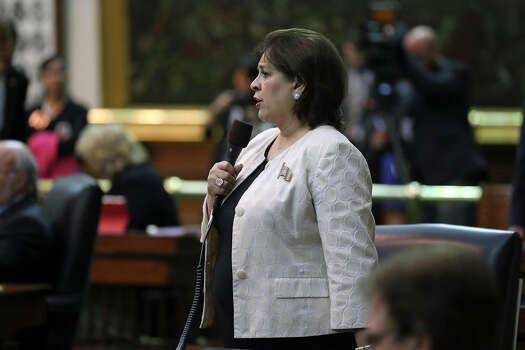
Letica Van de Putte is a State Senator representing San Antonio. She is chair of the Veteran Affairs and Military Installations Committee in the State Senate.
In this op-ed to the Houston Chronicle on 26 June 2013 she explains why she said what she said on Tuesday night during Senator Wendy Davis's filibuster of SB 5.
As most people know, I rushed back to the Capitol on Tuesday night after saying a final goodbye to my daddy. When I returned to the Senate floor, it didn't feel like the Senate I had left last Friday. There was an energy that is hard to explain - part tension and part excitement. While you could cut the tension on the floor with a knife, the excitement coming from the gallery and the rotunda almost masked the anxiety my colleagues were emitting. The entire gallery was filled with our constituents, and they were watching politely and attentively trying to follow parliamentary procedures that it takes years for most to understand.
Their disdain for Senate Bill 5 was much like mine, and they were there to say that they would never surrender their reproductive rights without taking a stand. They were "standing with Wendy" (Fort Worth Sen. Wendy Davis, who was attempting a 13-hour filibuster of the bill), and I was going to stand with her, too.
I believe that women throughout our state believe they've gained too much to give it back now.
Unfortunately, some of my Senate colleagues do not believe in trusting women with their reproductive organs. It's amazing to me that they do not trust women with a choice, but they trust them with a child.
I was horrified when I learned that SB 5 potentially could leave the state with only five abortion clinics, and they were all in major metropolitan areas.
I thought, "What is going to happen when a woman working two jobs out in West Texas finds out she is pregnant?" Maybe her pregnancy was an accident. Maybe she was raped. Whatever the reason, she is scared and desperate to terminate her pregnancy. And she has a legal right to do it.
But whether she would be able to exercise this right was another question.
Had SB 5 passed, this woman would have had to take time off from work and drive hours to find one of the five clinics to perform her abortion. Once she found a clinic, she would have to obtain a sonogram and wait 24 hours to obtain her abortion. This young woman would then take a pill at the clinic, wait 48 additional hours and then come back to the clinic to take an additional pill. This young woman has been away from her home and her job for at least four days. That's no small matter in any instance, but it makes it impossible if she doesn't have the monetary means to leave her job for an extended period of time.
I don't see how limiting access and choice is anything more than hardship and harassment, especially to the poor.
We advocates of reproductive choices often say that we want to make abortion safe, legal and rare. While those who push anti-choice legislation will likely never agree with us on the "legal" part, I think we can agree on the other two. But the "rare" part cannot come from making abortion inaccessible. It needs to come from making it unnecessary.
That can happen through better health care. If the state is truly concerned with women's and children's health, why do we cut women off from Medicaid 60 days post-partum?
So yesterday, I stood with Wendy while she filibustered a bill that would cut access to women's health care. And while the lieutenant governor may believe that his constituents who were in their Capitol were an "unruly mob using Occupy Wall Street tactics," I believe that these Texans were only using their voices to be heard after days of being shut off. They were venting their anger after seeing the rules of the Senate cast aside by the Republican leadership, as well as possible violations of state law.
They were taking a stand for a constitutionally protected right, and I encourage them to never sit down.
Sunday, 30 June 2013

The Daily Show with Jon Stewart (hosted by John Oliver) takes on Senator Davis's filibuster from Tuesday Night. Jon Stewart John Oliver points out that this has overshadowed the big same-sex marriage cases delivered by the Supreme Court on Wednesday.
They simply believe that if late one night when you're swept away by your emotions, you make a stupid mistake, you should always have a chance to fix it later and not have to live with the consequences.
- John Oilver, The Daily Show, 26 June 2013
The Daily Show also takes on the larger abortion debate with Senior Women's Issues Correspondent Kristen Schaal.
Subscribe to:
Posts (Atom)


