


Showing posts with label Politics. Show all posts
Showing posts with label Politics. Show all posts
Tuesday, 10 September 2013
Sunday, 8 September 2013

Congress returns from their summer recess on Monday.
I too have taken one myself, but I think mine was more productive than Congress's break.
Before leaving DC to return to their districts, the House took care of one piece of business.
Repealing "ObamaCare."
 Since Republicans took control of the House as a result of the November 2010 election, they have pursued this endless quest of repealing the cornerstone of President Obama's agenda and what will certainly be a historic piece of legislation once he leaves office 20 January 2017. "ObamaCare" or the Affordable Care Act of 2010 as it is correctly known as, survived a Supreme Court challenge in June 2012 where the conservative-leaning Chief Justice John Roberts cast the deciding vote in the landmark case. "ObamaCare" survived the Presidential election and campaign against the original author of "ObamaCare".
It will survive the votes that House Republicans will continue to make. These votes are nothing more than symbolic and have now become... well... sad. On the last day before the summer recess, this was the 40th vote that the House GOP has scheduled to repeal "ObamaCare." Senator Harry Reid (D, NV) got the memo and it immediately went into this file:

The House can hold their little vote to repeal "ObamaCare" but all it is theatrics. It won't come up for a vote in the Senate because Democrats are the majority party in that chamber. The only way if it comes up for a vote in the Senate is if Republicans take control of that chamber and while that is a possibility in 2014, right now I cannot see that happening given the mood of the country toward Congressional Republicans.
But.... as much as I hate it, let's play the "What If" Game. Say the GOP gets the Senate in the 2014 mid-terms as Nate Silver is predicting and the GOP holds the House. So you have a Republican controlled Congress.... and a Democratic President. Nate Silver projects that the GOP will have a slim majority in the Senate, 51 seats to be exact. If the GOP was serious about repealing "ObamaCare" they'd fight to get veto-proof majorities in the House and Senate. To override a presidential veto it takes a two-thirds vote in both chambers to do so.
So.... if my math is correct, two-thirds in the House is 290 votes and that same threshold is 67 votes in the Senate. The best the GOP can do in the House is get to 240 seats as shown during the 2010 mid-terms. The path to 67 votes in the Senate is impossible. Even if the GOP wins ALL of the Senate races in 2014, they would still end up one seat short.
So, veto-proof majorities are out of the question. They could try impeachment of President Obama and Vice President Biden, but it would be some bullshit charges that would backfire on the GOP so quickly that their party would become irrelevant in not just Presidential Elections, but also down ballots.
Oh... and speaking of Presidential Elections, there is one in 2016 which is its own nasty animal given that the GOP has a BIG problem courting key demographics such as Women and Hispanics.
So while the GOP controlled Congress in this "What If" Game passes the "ObamaCare" repeal bill out of their chamber and Obama takes out his big red rubber "VETO" stamp to it and the Congress doesn't have a two-thirds vote in EITHER chamber to override his veto, the electorate is getting sick and tired of this dog and pony show. President Obama will act like the adult as he always does and keep his mind on the long game.
In this case, the long game is ensuring that Obama's party controls the White House until at least 20 January 2021... maybe 20 January 2025 given the inability of the Republican Party to cope with America's changing voting demographics. Meanwhile the Republicans will be unaware of that the public has become tired of their consistent efforts to block legislative proposals by their Democratic colleagues in the Congress and President Obama.
For starters, let's start with something that I am passionate about: infrastructure, in particular roads.
In the five years that I have lived in Texas since I've almost driven the entire length of Interstate 35 through Texas. I cannot count how many times I have gone down to Austin in this time period.
Since my first post-Navy trip to Austin in December 2008, I have seen the construction project taking place along I-35. The plan is to widen I-35 between Hillsboro and Austin to where it is at least a three-lane freeway in both directions. The two-way frontage roads will become relics of the past and give way to the one-way frontage roads that are common in the highly urbanized areas. This construction project along I-35 is in part due to most of the population in Texas resides along this interstate and the freeway is a major north-south route for transit through the middle of the United States as it starts at the US-Mexico border in Laredo, goes through San Antonio, Austin, splits into E-W branches when it reaches the Metroplex, and heads north into Oklahoma City, Kansas City, Iowa, splits into another set of E-W branches at Minneapolis-St. Paul and ends in Duluth, MN.
Even though we have made advances in travel, we are still a nation that predominantly travels by car. We need high quality roads if we are to maintain our global economic advantage. Case in point: this story from the Texas Tribune about roads in South and West Texas being downgraded to gravel.
While there is this major construction project going on between Hillsboro and San Antonio, let's see about what is going on in the Metroplex.
The last time there was major improvements to I-35 in the Metroplex was to the widen the original stretch of I-35W from Downtown Fort Worth to I-20 in the late 1980s. As shown in the pictures below, I-35W opened in 1957 and was still designated the old US-81 signage.


When the freeway was widened in the 1980s it also included a new stack interchange at I-20.


The next major improvement was replacing the old interchange at I-35W and I-30. The project was completed at the turn of the century and involved redirecting I-30 to its current location south of the Fort Worth post office and a new stack interchange that also involved a more direct connection with South I-35W to South US-287.

But since then, there has not been any major improvements to I-35W or I-35E in Dallas as the population of the Metroplex continues to grow especially in the suburban areas of the northern parts of Tarrant and Dallas Counties. Currently construction is taking place along I-35W between Alliance Airport to Loop 820 in Tarrant County as part of the larger North Tarrant Express project. Just recently there was an announcement about the widening of I-35E from US-380 in Denton to the LBJ/635 interchange in Dallas will begin this year. These were roads that needed to widened at least 15 years ago to keep up with the growing population.
While I understand that there is a LOT of planning that goes into freeway widening and these roads go through highly suburban and urban areas, eventually there needs to be some kind of action. My fellow drivers and I are getting tired of sitting through traffic on poorly maintained roads.
This is how bad I-35E is in Denton.

As shown by the picture, it is still a two-lane freeway. No left shoulder. Hardly any right shoulder. If a car breaks down or there is a nasty accident on this portion that goes near the UNT campus, all traffic will stop.
Traveling south on I-35E from Downtown Dallas to the split at US-67 in Oak Cliff is no better. That road is BADLY needing repaving... you know what, (expletive deleted) it, it needs to be replaced.
So, what does this have to do with the Republicans consistent voting on repealing "ObamaCare?"
House Republicans can hold these votes to repeal "ObamaCare" and in some cases threaten a government shutdownall day long, but it will not solve the problems our country faces. Eventually after the campaigning and grandstanding, you have to GOVERN. And frankly as I have stated SEVERAL times, the Republicans have FAILED at it.
If you thought the 112th Congress was unproductive, the 113th has been no better. Prior to going on their summer vacation, the House passed 15 bills compared to 23 bills at that same junction in 2011. Right now at this pace the House is on pace to pass 60 bills which is far fewer than the 219 bills passed by the previous congress.
As witnessed with the Violence Against Women Actand Hurricane Sandy Relief Bill, Republicans are the ones who are kicking and screaming in order to get the most basic forms of legislation passed.
"Why should we pass a Violence Against Women Act?"
Because a Justice Department study shows that the rate of sexual violence against women and girls age 12 or over has fallen 64% in the 10 years it has existed. Eleanor Smeal, president of the Feminist Majority, stated that despite these positive statistics, "It is clear there is still too much violence and too many are fearful to report it."
"Why should we provide disaster relief? Those people are idiots for living in places that are hit by storms."
These folks are anti-relief. That is UNTIL a disaster strikes their community and suddenly...
You can read my thoughts on these folks here (West Fertilizer Plant)and here (Texas and Oklahoma tornadoes).
The American public and myself are not too confident about Congress tackling the serious issues like Employee Nondiscrimination Act (ENDA) and Comprehensive Immigration Reform.
That is correct. Work only 9 days after a month long vacation.
And they wonder why folks are not big fans of the legislative branch.
And two, there is the looming debt ceiling crisisthat is expected to dominate when Congress returns.

But here is the main point that I am FINALLY making....
Right now there is a serious debate about whether we should intervene in the Syrian Civil War. While the Senate has cut short their vacation and returned to Washington to participate in hearings, the House appears to be in no hurry to participate.
GOP in Congress: "WE DEMAND A VOTE ON SYRIA!!!!!!" President Obama: Okay." GOP in Congress: "Oh shit."
— TheObamaDiary.com (@TheObamaDiary) August 31, 2013
A whip count from Friday shows that it is likely to be defeated in the House with a majority of support coming from Republicans. I can't tell if they are being sincere about not wanting to put American forces in harm's way and they have learned the lessons from The Iraq War or this is just another political power play.
Recall the sequester when it happened earlier this year? I recall Rachel Maddow saying this in an interview with The Today Showwhen it happened:
"The bigger problem is crisis-to-crisis-to-crisis is not the way the biggest country on earth should govern itself. Other countries spend their time trying to build up their resilience. We, instead, invent our own crises."
Which is very true. Instead of actually taking on and solving the REAL problems our country faces, the House GOP manufactures crises. Gutting food stamps, stalling disaster aid relief, discussing whether women have access to contraception, voting to defund ObamaCare, and threatening to shutdown the government which would damage the slowly recovering economy because Republicans don't get everything what they want.
This does not instill a lot of confidence in governing.
If there is any reason why the GOP needs to be voted out of governing in 2014, this is it right here. The House GOP is great at channeling the faux outrage of their manufactured media machinery while inside the bubble...
BUT...
When it comes time to step out of the bubble and participate with the rest of the country, they are nowhere to be found.
This should serve as a reminder to why elections matter and why it is important to put competent people in charge of governing.
Otherwise... we get a useless House.
Wednesday, 24 July 2013
Earlier today, President Barack Obama delivered the first in a series of speeches regarding the economy. Text provided at this link and below.

Eight years ago, I came here to deliver the commencement address for the class of 2005. Things were a little different back then. I didn’t have any gray hair, for example. Or a motorcade. I didn’t even have a teleprompter. It was my first big speech as your newest senator, and I spent my time talking about what a changing economy was doing to the middle class – and what we, as a country, needed to do to give every American a chance to get ahead in the 21st century.
You see, I’d just spent a year traveling this state and listening to your stories – of proud Maytag workers losing their jobs when their plant moved down to Mexico; of teachers whose salaries weren’t keeping up with the rising cost of groceries; of young people who had the drive but not the money to afford a college education.
They were the stories of families who worked hard and believed in the American Dream, but felt that the odds were increasingly stacked against them. And they were right.
In the period after World War II, a growing middle class was the engine of our prosperity. Whether you owned a company, swept its floors, or worked anywhere in between, this country offered you a basic bargain – a sense that your hard work would be rewarded with fair wages and benefits, the chance to buy a home, to save for retirement, and, above all, to hand down a better life for your kids.
But over time, that engine began to stall. That bargain began to fray. Technology made some jobs obsolete. Global competition sent others overseas. It became harder for unions to fight for the middle class. Washington doled out bigger tax cuts to the rich and smaller minimum wage increases for the working poor. The link between higher productivity and people’s wages and salaries was severed – the income of the top 1% nearly quadrupled from 1979 to 2007, while the typical family’s barely budged.
Towards the end of those three decades, a housing bubble, credit cards, and a churning financial sector kept the economy artificially juiced up. But by the time I took office in 2009, the bubble had burst, costing millions of Americans their jobs, their homes, and their savings. The decades-long erosion of middle-class security was laid bare for all to see and feel.
Today, five years after the start of that Great Recession, America has fought its way back.
Together, we saved the auto industry, took on a broken health care system, and invested in new American technologies to reverse our addiction to foreign oil and double wind and solar power.
Together, we put in place tough new rules on big banks, and protections that cracked down on the worst practices of mortgage lenders and credit card companies. We changed a tax code too skewed in favor of the wealthiest at the expense of working families, locking in tax cuts for 98% of Americans, and asking those at the top to pay a little more.
Add it all up, and over the past 40 months, our businesses have created 7.2 million new jobs. This year, we are off to our strongest private-sector job growth since 1999. And because we bet on this country, foreign companies are, too. Right now, more of Honda’s cars are made in America than anywhere else. Airbus will build new planes in Alabama. Companies like Ford are replacing outsourcing with insourcing and bringing more jobs home. We sell more products made in America to the rest of the world than ever before. We now produce more natural gas than any country on Earth. We’re about to produce more of our own oil than we buy from abroad for the first time in nearly 20 years. The cost of health care is growing at its slowest rate in 50 years. And our deficits are falling at the fastest rate in 60 years.
Thanks to the grit and resilience of the American people, we’ve cleared away the rubble from the financial crisis and begun to lay a new foundation for stronger, more durable economic growth. In our personal lives, we tightened our belts, shed debt, and refocused on the things that really matter. As a country, we’ve recovered faster and gone further than most other advanced nations in the world. With new American revolutions in energy, technology, manufacturing, and health care, we are actually poised to reverse the forces that have battered the middle class for so long, and rebuild an economy where everyone who works hard can get ahead.
But I’m here today to tell you what you already know – we’re not there yet. Even though our businesses are creating new jobs and have broken record profits, nearly all the income gains of the past ten years have continued to flow to the top 1%. The average CEO has gotten a raise of nearly 40% since 2009, but the average American earns less than he or she did in 1999. And companies continue to hold back on hiring those who have been out of work for some time.
Today, more students are earning their degree, but soaring costs saddle them with unsustainable debt. Health care costs are slowing, but many working families haven’t seen the savings yet. And while the stock market rebound has helped families get back much of what they lost in their 401ks, millions of Americans still have no idea how they’ll ever be able to retire. In many ways, the trends that I spoke of here in 2005 – of a winner-take-all economy where a few do better and better, while everybody else just treads water – have been made worse by the recession.
This growing inequality isn’t just morally wrong; it’s bad economics. When middle-class families have less to spend, businesses have fewer customers. When wealth concentrates at the very top, it can inflate unstable bubbles that threaten the economy. When the rungs on the ladder of opportunity grow farther apart, it undermines the very essence of this country.
That’s why reversing these trends must be Washington’s highest priority. It’s certainly my highest priority. Unfortunately, over the past couple of years in particular, Washington hasn’t just ignored the problem; too often, it’s made things worse.
We’ve seen a sizable group of Republican lawmakers suggest they wouldn’t vote to pay the very bills that Congress rang up – a fiasco that harmed a fragile recovery in 2011, and one we can’t afford to repeat. Then, rather than reduce our deficits with a scalpel – by cutting programs we don’t need, fixing ones we do, and making government more efficient – this same group has insisted on leaving in place a meat cleaver called the sequester that has cost jobs, harmed growth, hurt our military, and gutted investments in American education and scientific and medical research that we need to make this country a magnet for good jobs.
Over the last six months, this gridlock has gotten worse. A growing number of Republican Senators are trying to get things done, like an immigration bill that economists say will boost our economy by more than a trillion dollars. But a faction of Republicans in the House won’t even give that bill a vote, and gutted a farm bill that America’s farmers and most vulnerable children depend on.
If you ask some of these Republicans about their economic agenda, or how they’d strengthen the middle class, they’ll shift the topic to “out-of-control” government spending – despite the fact that we have cut the deficit by nearly half as a share of the economy since I took office. Or they’ll talk about government assistance for the poor, despite the fact that they’ve already cut early education for vulnerable kids and insurance for people who’ve lost their jobs through no fault of their own. Or they’ll bring up Obamacare, despite the fact that our businesses have created nearly twice as many jobs in this recovery as they had at the same point in the last recovery, when there was no Obamacare.
With an endless parade of distractions, political posturing and phony scandals, Washington has taken its eye off the ball. And I am here to say this needs to stop. Short-term thinking and stale debates are not what this moment requires. Our focus must be on the basic economic issues that the matter most to you – the people we represent. And as Washington prepares to enter another budget debate, the stakes for our middle class could not be higher. The countries that are passive in the face of a global economy will lose the competition for good jobs and high living standards. That’s why America has to make the investments necessary to promote long-term growth and shared prosperity. Rebuilding our manufacturing base. Educating our workforce. Upgrading our transportation and information networks. That’s what we need to be talking about. That’s what Washington needs to be focused on.
And that’s why, over the next several weeks, in towns across this country, I will engage the American people in this debate. I will lay out my ideas for how we build on the cornerstones of what it means to be middle class in America, and what it takes to work your way into the middle class in America. Job security, with good wages and durable industries. A good education. A home to call your own. Affordable health care when you get sick. A secure retirement even if you’re not rich. Reducing poverty and inequality. Growing prosperity and opportunity.
Some of these ideas I’ve talked about before, and some will be new. Some will require Congress, and some I will pursue on my own. Some will benefit folks right away; some will take years to fully implement. But the key is to break through the tendency in Washington to careen from crisis to crisis. What we need isn’t a three-month plan, or even a three-year plan, but a long-term American strategy, based on steady, persistent effort, to reverse the forces that have conspired against the middle class for decades.
Of course, we’ll keep pressing on other key priorities, like reducing gun violence, rebalancing our fight against al Qaeda, combating climate change, and standing up for civil rights and women’s rights. But if we don’t have a growing, thriving middle class, we won’t have the resources or the resolve; the optimism or sense of unity that we need to solve these other issues.
In this effort, I will look to work with Republicans as well as Democrats wherever I can. I believe there are members of both parties who understand what’s at stake, and I will welcome ideas from anyone, from across the political spectrum. But I will not allow gridlock, inaction, or willful indifference to get in our way. Whatever executive authority I have to help the middle class, I’ll use it. Where I can’t act on my own, I’ll pick up the phone and call CEOs, and philanthropists, and college presidents – anybody who can help – and enlist them in our efforts. Because the choices that we, the people, make now will determine whether or not every American will have a fighting chance in the 21st century.
Let me give you a quick preview of what I’ll be fighting for and why.
The first cornerstone of a strong and growing middle class has to be an economy that generates more good jobs in durable, growing industries. Over the past four years, for the first time since the 1990s, the number of American manufacturing jobs hasn’t gone down; they’ve gone up. But we can do more. So I’ll push new initiatives to help more manufacturers bring more jobs back to America. We’ll continue to focus on strategies to create good jobs in wind, solar, and natural gas that are lowering energy costs and dangerous carbon pollution. And I’ll push to open more manufacturing innovation institutes that turn regions left behind by global competition into global centers of cutting-edge jobs. Let’s tell the world that America is open for business – including an old site right here in Galesburg, over on Monmouth Boulevard.
Tomorrow, I’ll also visit the port of Jacksonville, Florida to offer new ideas for doing what America has always done best: building things. We’ve got ports that aren’t ready for the new supertankers that will begin passing through the new Panama Canal in two years’ time. We’ve got more than 100,000 bridges that are old enough to qualify for Medicare. Businesses depend on our transportation systems, our power grids, our communications networks – and rebuilding them creates good-paying jobs that can’t be outsourced. And yet, as a share of our economy, we invest less in our infrastructure than we did two decades ago. That’s inefficient at a time when it’s as cheap as it’s been since the 1950s. It’s inexcusable at a time when so many of the workers who do this for a living sit idle. The longer we put this off, the more expensive it will be, and the less competitive we will be. The businesses of tomorrow won’t locate near old roads and outdated ports; they’ll relocate to places with high-speed internet; high-tech schools; systems that move air and auto traffic faster, not to mention get parents home to their kids faster. We can watch that happen in other countries, or we can choose to make it happen right here, in America.
In an age when jobs know no borders, companies will also seek out the country that boasts the most talented citizens, and reward them with good pay. The days when the wages for a worker with a high-school degree could keep pace with the earnings of someone who got some higher education are over. Technology and global competition aren’t going away. So we can either throw up our hands and resign ourselves to diminished living standards, or we can do what America has always done: adapt, pull together, fight back and win.
Which brings me to the second cornerstone of a strong middle class: an education that prepares our children and our workers for the global competition they’ll face.
If you think education is expensive, wait until you see how much ignorance costs in the 21st century. If we don’t make this investment, we’ll put our kids, our workers, and our country at a competitive disadvantage for decades. So we must begin in the earliest years. That’s why I’ll keep pushing to make high-quality preschool available to every four year-old in America – not just because we know it works for our kids, but because it provides a vital support system for working parents. I’ll also take action to spur innovation in our schools that don’t require Congress. Today, for example, federal agencies are moving on my plan to connect 99% of America’s students to high-speed internet over the next five years. And we’ve begun meeting with business leaders, tech entrepreneurs, and innovative educators to identify the best ideas for redesigning our high schools so that they teach the skills required for a high-tech economy.
We’ll also keep pushing new efforts to train workers for changing jobs. Here in Galesburg, many of the workers laid off at Maytag chose to enroll in retraining programs like the ones at Carl Sandburg College. And while it didn’t pay off for everyone, many who retrained found jobs that suited them even better and paid even more. That’s why I asked Congress to start a Community College to Career initiative, so that workers can earn the skills that high-tech jobs demand without leaving their hometown. And I’m challenging CEOs from some of America’s best companies to hire more Americans who’ve got what it takes to fill that job opening, but have been laid off so long no one will give their resume an honest look.
I’m also going to use the power of my office over the next few months to highlight a topic that’s straining the budgets of just about every American family – the soaring cost of higher education.
Three years ago, I worked with Democrats to reform the student loan system so that taxpayer dollars stopped padding the pockets of big banks, and instead helped more kids afford college. I capped loan repayments at 10% of monthly income for responsible borrowers. And this week, we’re working with both parties to reverse the doubling of student loan rates that occurred a few weeks ago because of Congressional inaction.
It’s all a good start – but it isn’t enough. Families and taxpayers can’t just keep paying more and more into an undisciplined system; we’ve got to get more out of what we pay for. Some colleges are testing new approaches to shorten the path to a degree, or blending teaching with online learning to help students master material and earn credits in less time. Some states are testing new ways to fund college based not just on how many students enroll, but how well they do. This afternoon, I’ll visit the University of Central Missouri to highlight their efforts to deliver more bang for the buck. And in the coming months, I will lay out an aggressive strategy to shake up the system, tackle rising costs, and improve value for middle-class students and their families.
Now, if a good job and a good education have always been key stepping stones into the middle class, a home of your own has been the clearest expression of middle-class security. That changed during the crisis, when millions of middle-class families saw their home values plummet. Over the past four years, we’ve helped more responsible homeowners stay in their homes, and today, sales are up, prices are up, and fewer Americans see their homes underwater.
But we’re not done yet. The key now is to encourage homeownership that isn’t based on bubbles, but is instead based on a solid foundation, where buyers and lenders play by the same set of rules, rules that are clear, transparent, and fair. Already, I’ve asked Congress to pass a good, bipartisan idea – one that was championed by Mitt Romney’s economic advisor – to give every homeowner the chance to refinance their mortgage and save thousands of dollars a year. I’m also acting on my own to cut red tape for responsible families who want to get a mortgage, but the bank says no. And we’ll work with both parties to turn the page on Fannie and Freddie, and build a housing finance system that’s rock-solid for future generations.
Along with homeownership, the fourth cornerstone of what it means to be middle class in this country is a secure retirement. Unfortunately, over the past decade, too many families watched their retirement recede from their grasp. Today, a rising stock market has millions of retirement balances rising. But we still live with an upside-down system where those at the top get generous tax incentives to save, while tens of millions of hardworking Americans get none at all. As we work to reform our tax code, we should find new ways to make it easier for workers to put money away, and free middle-class families from the fear that they’ll never be able to retire. And if Congress is looking for a bipartisan place to get started, they don’t have to look far: economists show that immigration reform that makes undocumented workers pay their full share of taxes would actually shore up Social Security for years.
Fifth, I will keep focusing on health care, because middle-class families and small business owners deserve the security of knowing that neither illness nor accident should threaten the dreams you’ve worked a lifetime to build.
As we speak, we are well on our way to fully implementing the Affordable Care Act. If you’re one of the 85% of Americans who already have health insurance, you’ve got new benefits and better protections you didn’t have before, like free checkups and mammograms and discounted medicine on Medicare. If you don’t have health insurance, starting October 1st, private plans will actually compete for your business. You can comparison shop in an online marketplace, just like you would for TVs or plane tickets, and buy the one that fits your budget and is right for you. And if you’re in the up to half of all Americans who’ve been sick or have a preexisting condition, this law means that that beginning January 1st, insurance companies finally have to cover you, and at the same rates they charge everybody else.
Now, I know there are folks out there who are actively working to make this law fail. But despite a politically-motivated misinformation campaign, the states that have committed themselves to making this law work are finding that competition and choice are actually pushing costs down. Just last week, New York announced that premiums for consumers who buy their insurance in these online marketplaces will be at least 50% less than what they pay today. That’s right – folks’ premiums in the individual market will drop by 50%. For them, and for the millions of Americans who have been able to cover their sick kids for the first time, or have been able to cover their employees more cheaply, or who will be getting tax breaks to afford insurance for the first time – you will have the security of knowing that everything you’ve worked hard for is no longer one illness away from being wiped out.
Finally, as we work to strengthen these cornerstones of middle-class security, I’m going to make the case for why we need to rebuild ladders of opportunity for all those Americans still trapped in poverty. Here in America, we’ve never guaranteed success. More than some other countries, we expect people to be self-reliant, and we’ve tolerated a little more inequality for the sake of a more dynamic, more adaptable economy. But that’s always been combined with a commitment to upward mobility – the idea that no matter how poor you started, you can make it with hard work and discipline.
Unfortunately, opportunities for upward mobility in America have gotten harder to find over the past 30 years. That’s a betrayal of the American idea. And that’s why we have to do a lot more to give every American the chance to work their way into the middle class.
The best defense against all of these forces – global competition and economic polarization – is the strength of community. We need a new push to rebuild run-down neighborhoods. We need new partnerships with some of the hardest-hit towns in America to get them back on their feet. And because no one who works full-time in America should have to live in poverty, I will keep making the case that we need to raise a minimum wage that in real terms is lower than it was when Ronald Reagan took office. We are not a people who allow chance of birth to decide life’s big winners and losers; and after years in which we’ve seen how easy it can be for any of us to fall on hard times, we cannot turn our backs when bad breaks hit any of our fellow citizens.
Good jobs. A better bargain for the middle class and folks working to join it. An economy that grows from the middle-out. This is where I will focus my energies – not just over the next few months, but for the remainder of my presidency. These are the plans that I will lay out across this country. But I won’t be able to do it alone, and I’ll be calling on all of us to take up this cause.
We’ll need our businesses, the best in the world, to pressure Congress to invest in our future, and set an example by providing decent wages and salaries to their own employees. And I’ll highlight the ones that do just that – companies like Costco, which pays good wages and offers good benefits; or the Container Store, which prides itself on training its workers and on employee satisfaction – because these companies prove that this isn’t just good for their business, it’s good for America.
We’ll need Democrats to question old assumptions, be willing to redesign or get rid of programs that no longer work, and embrace changes to cherished priorities so that they work better in this new age. For if we believe that government can give the middle class a fair shot in this new century, we have an obligation to prove it.
And we’ll need Republicans in Congress to set aside short-term politics and work with me to find common ground. The fact is, there are Republicans in Congress right now who privately agree with me on many of the ideas I’ll be proposing, but worry they’ll face swift political retaliation for saying so. Others will dismiss every idea I put forward either because they’re playing to their most strident supporters, or because they have a fundamentally different vision for America – one that says inequality is both inevitable and just; one that says an unfettered free market without any restraints inevitably produces the best outcomes, regardless of the pain and uncertainty imposed on ordinary families.
In either case, I say to these members of Congress: I am laying out my ideas to give the middle class a better shot. Now it’s time for you to lay out yours. If you’re willing to work with me to strengthen American manufacturing and rebuild this country’s infrastructure, let’s go. If you have better ideas to bring down the cost of college for working families, let’s hear them. If you think you have a better plan for making sure every American has the security of quality, affordable health care, stop taking meaningless repeal votes and share your concrete ideas with the country. If you are serious about a balanced, long-term fiscal plan that replaces the mindless cuts currently in place, or tax reform that closes corporate loopholes and gives working families a better deal, I’m ready to work – but know that I will not accept deals that do not meet the test of strengthening the prospects of hard-working families.
We’ve come a long way since I first took office. As a country, we’re older and we’re wiser. And as long as Congress doesn’t manufacture another crisis – as long as we don’t shut down the government just as the economy is getting traction, or risk a U.S. default over paying bills we’ve already racked up – we can probably muddle along without taking bold action. Our economy will grow, though slower than it should; new businesses will form, and unemployment will keep ticking down. Just by virtue of our size and our natural resources and the talent of our people, America will remain a world power, and the majority of us will figure out how to get by.
But if that’s our choice – if we just stand by and do nothing in the face of immense change – understand that an essential part of our character will be lost. Our founding precept about wide-open opportunity and each generation doing better than the last will be a myth, not reality. The position of the middle class will erode further. Inequality will continue to increase, and money’s power will distort our politics even more. Social tensions will rise, as various groups fight to hold on to what they have, and the fundamental optimism that has always propelled us forward will give way to cynicism or nostalgia.
That’s not the vision I have for this country. That’s not the vision you have for this country. That is not the America we know. That’s not a vision we should settle for, or pass on to our children. I have now run my last campaign. I do not intend to wait until the next one before tackling the issues that matter. I care about one thing and one thing only, and that’s how to use every minute of the 1,276 days remaining in my term to make this country work for working Americans again. Because I believe this is where America needs to go. I believe this is where the American people want to go. It may seem hard today, but if we are willing to take a few bold steps – if Washington will just shake off its complacency and set aside the kind of slash-and-burn partisanship we’ve seen these past few years – our economy will be stronger a year from now. And five years from now. And ten years from now. More Americans will know the pride of that first paycheck; the satisfaction of flipping the sign to “Open” on their own business; the joy of etching a child’s height into the door of their brand new home.
After all, what makes us special has never been our ability to generate incredible wealth for the few, but our ability to give everyone a chance to pursue their own true measure of happiness. We haven’t just wanted success for ourselves – we’ve wanted it for our neighbors, too. That’s why we don’t call it John’s dream or Susie’s dream or Barack’s dream – we call it the American Dream. That’s what makes this country special – the idea that no matter who you are, what you look like, where you come from or who you love – you can make it if you try.
One of America’s greatest writers, Carl Sandburg, was born right here in Galesburg over a century ago. He saw the railroad bring the world to the prairie, and the prairie send its bounty to the world. He saw the advent of bustling new industries and technologies; he watched populations shift; he saw fortunes made and lost. He saw how change could be painful – how a new age could unsettle long-settled customs and ways of life. But possessed with a frontier optimism, he saw something more on the horizon. “I speak of new cities and new people,” he wrote. “…The past is a bucket of ashes…yesterday is a wind gone down, a sun dropped in the west…there is…only an ocean of tomorrows, a sky of tomorrows.”
America, we have made it through the worst of yesterday’s winds. And if we find the courage to keep moving forward; if we set our eyes on the horizon, we too will find an ocean of tomorrows, a sky of tomorrows – for America’s people, and for this great country that we love.
Thank you, God bless you, and God bless the United States of America.
Sunday, 21 July 2013

Texas passed its omnibus anti-choice legislation one week ago by a vote of 19-11 in the State Senate. This last Thursday Governor Rick Perry (R) signed it.
At the same time the US House approved a farm bill without funding food stamps by a vote of 216-208. The debate was heated with Democrats accusing Republicans of dismissing low income Americans while Republicans did what they could do stifle vocal opposition.
These two polices passed by Republicans at the state level in Texas and the national level are summed up by Rachel Maddow's quotein her analysis of President Obama's re-election speech as she was commenting about what the real political divisions in this country are.
The biggest political divide in this country is not between Democrats and Republicans, it's between who care and people who don't.
Republicans do not care about the rest of their constituents.
They only care about those that participate in the Republican Primary and those that fund their campaigns.
My State Rep, State Senator, US House Member, and US Senators do not care about me. I didn't vote for them, but I expect that they would hear me out because they were elected to represent me. Honestly, they don't represent the interests of me or my friends that fall into the same category as me.
I reached that conclusion during the Texas Senate's HB 2 debate.
During the debate, Senate Democrats offered 20 amendments to try to lessen the blow of the proposed legislation and back to the House for reconsideration. Among those amendments were restoring funding to the cuts to family planning services and education that happened in the 82nd session to teaching age appropriate comprehensive sex education to Senator Wendy Davis's "Equal Pay for Equal Work" proposal.
All 20 amendments were tabled.
By the end of that night, the bill passed as expected.
I made this observation at the start of these special sessions back on 31 May 2013:
This special session is nothing more than an opportunity for the very vocal minority of Tea Party Republicans to push forward their agenda and to prevent some legislators from seeing a formidable primary challenger in 2014. State level Republicans know they are going to get hammered on issues such as the budget and not pushing enough of an extreme agenda by their base.
I later expanded on that observation in the days after Senator Davis's filibuster at the end of the first special session.
One of the reasons for passing this anti-choice omnibus bill was the argument coming from Republicans saying that fetuses feel pain at 20 weeks. I asked this question via twitter:
The #TXGOP's argument is preventing pain for 20 wk fetus. What about the pain of a live child going hungry? #TXLege#SB1#HB2#SWTW
— Michael Watts (@mjwatts1983) July 12, 2013
I had a few responses to this tweet. They were from your stereotypical right-wing Tea Partier types. What did I do?
Blocked them.
The fetal pain theory is bunk(among OTHER anti-choice theories that are circulating the so called "pro-life" movement and Republican politics). A British study says that fetuses cannot feel pain until 24 weeks while an American study says it is much later at 28 weeks. The reason for these findings is that fetuses' have not developed the nervous system to feel pain.
Also, a 2005 study by the Centers For Disease Control published that less than 1.3% of all abortions occur after 21 weeks.
Or in other words, science.
Another issue that Texas Republicans are claiming is that they want to make health care for women safer.
So how safe are abortions in Texas? 22% of abortions in Texaswere preformed in facilities classified as ambulatory surgical centers while the rest were preformed in clinics that don't meet HB 2's standards. According to the health department, the type of clinic has no impact on safety where the abortion is preformed.
HB 2 was not based on sound science or making health care for women safer. Instead it will punish poor women and women of color as they seek unsafe alternative methods to terminate a pregnancy such as purchasing abortion inducing drugs on the Black Market or worse... going to medical providers who will butcher a woman.
I know I have said it once in prior entries, but it is worth repeating.
HB 2's passage was nothing more than political gamesmanship to satisfy the rabid Tea Party base going into the 2014 elections. Texas Republicans pushed their luck and they have lost. There is a sense of anger among people on my side of the aisle and we have had enough. This could be the beginning of the end of the Republican Party's almost 20-year hold on Texas politics.
 Back to my question that I tweeted asking about how can Texas Republicans care about fetus pain but not about the hunger pains of a child.
The Republican Party claims to be the party of "pro-life." There is a catch... they only care about you if you are a fetus. After you are born, you are on your own.
As shown with the farm bill, House Republicans passed a bill that gave subsidies to farmers and big agriculture businesses but no funding to food stamps. It is not just food stamps. Here in Texas, our legislature cut education funding. There is the issue of fracking which raises concerns about the quantity and quality of our water supply. And of course, for the 38th and 39th time, the House GOP voted to repeal ObamaCare. Meanwhile 1 out of 4 Texans are without healthcare coverage. Then there is the issue of that Republicans are refusing to taking on gun reform legislation because the NRA has them by their collective testicles threatens to run NRA backed candidates against them.
Oh and Lege Republicans have filed this bill, The Fetal Heartbeat Bill, that would criminalize an abortion where a heartbeat is detected. The bill is classified as "trigger" legislation meaning it will only take effect if the Supreme Court overturns Roe v. Wade (1973).
The bill was filed within minutes of Governor Perry signing HB 2.
So... back to the title of this entry.
My fellow Democrats/Liberal minded people can present Republicans with the facts and we can write letters, tweet them, call them, and show up physically to their offices in their district and the capitol building.
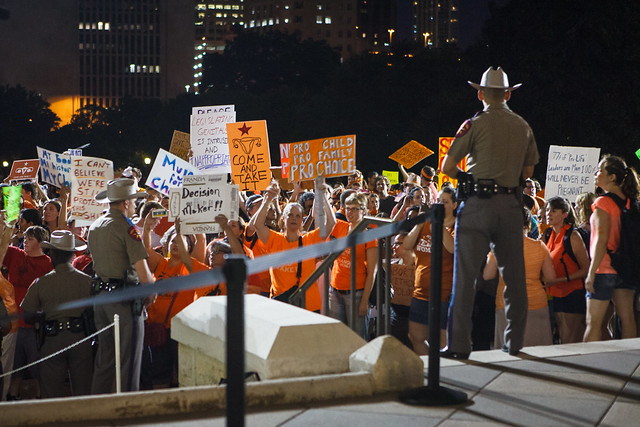
We can hold marches and yell and scream at them to vote for a position that we advocate, but as shown with the votes in The Lege and the US House, those actions did not sway their opinion.
You would think that when a crowd of this size....

from WITHIN TEXAS shows up to the Pink Dome in Austin, that Republicans in The Lege would stop and think about what they are doing.
But as shown with their votes, we don't matter to them.
When Republican politicians return to their districts the moment the Special Session adjourns sine die, they will brag about how they passed this anti-choice bill. The only thing these politicians will be proud about is they have something to shelter themselves going into the 2014 Republican Primaries which will be brutal for them. Other than that, this legislation does nothing to curb Texas's exploding teen birth rate. The Lege did nothing to ensure that future generations of Texans have access to health care with their constant moaning about how ObamaCare is an unfunded mandate (and HB 2 isn't?). And most telling is they didn't fully restore the education cuts that took place during the 82nd session and were unwilling to listen to Democrats proposals to make Texas a better state.
The sad part is they refused to listen to the voices of the victims of sexual assault who were traumatized by their experiences. Or the women who experienced a wide range of complications during their pregnancies that not only endangered the well-being and formation of the fetus but also jeopardized future pregnancies and in some instances endangered the health of the mother.

Because of their unwillingness to listen to the marginalized and only listening to the most extreme voices in their party, Republicans will pay a heavy price at the election booth come November 2014.
Eventually, we will stand up to these bullies.
Subscribe to:
Posts (Atom)


